Using Multer to Upload Files React Mongoose Deployed Site
Editor'southward notation: This article was final updated 24 March 2022 to reflect updates to Node.js and the torso-parser library.
Multer is a Node.js middleware for treatment multipart/form-data that makes the otherwise painstaking process of uploading files in Node.js much easier. In this commodity, nosotros'll acquire the purpose of Multer in handling files in submitted forms. We'll also explore Multer by building a mini app with a frontend and backend to test uploading a file. Let's become started!
Table of contents
- Managing user inputs in forms
- Encoding and uploading forms with Multer
- Multer: an overview
- Building an app with Multer support
- Creating our frontend
- Install and configure Multer
- Conclusion
Managing user inputs in forms
Spider web applications receive all different types of input from users, including text, graphical controls like checkboxes or radio buttons, and files, like images, videos, and other media.
In forms, each of these inputs are submitted to a server that processes the inputs, uses them in some way, perhaps saving them somewhere else, and then gives the frontend a success or failed response.
When submitting forms that contain text inputs, the server, Node.js in our case, has less work to do. Using Express, yous can easily grab all the inputs entered in the req.body object. However, submitting forms with files is a bit more complex because they require more processing, which is where Multer comes in.
Encoding and uploading forms with Multer
All forms include an enctype attribute, which specifies how data should be encoded past the browser before sending it to the server. The default value is application/ten-world wide web-grade-urlencoded, which supports alphanumeric data. The other encoding type is multipart/form-information, which involves uploading files through forms.
There are two ways to upload forms with multipart/form-data encoding. The start is by using the enctype attribute:
<grade action='/upload_files' enctype='multipart/class-data'> ... </form>
The code above sends the form-data to the /upload_files path of your awarding. The second is by using the FormData API. The FormData API allows u.s.a. to build a multipart/grade-data form with key-value pairs that can exist sent to the server. Here's how information technology's used:
const grade = new FormData() grade.append('proper name', "Dillion") form.append('prototype', <a file>) On sending such forms, it becomes the server'southward responsibility to correctly parse the form and execute the final functioning on the data.
Multer: an overview
Multer is a middleware designed to handle multipart/class-data in forms. It is similar to the popular Node.js torso-parser, which is built into Express middleware for form submissions. Simply, Multer differs in that it supports multipart data, only processing multipart/form-information forms.
Multer does the piece of work of body-parser by attaching the values of text fields in the req.body object. Multer also creates a new object for multiple files, eitherreq.file or req.files, which holds data near those files. From the file object, you can pick whatsoever data is required to post the file to a media direction API, like Cloudinary.
At present that we sympathize the importance of Multer, we'll build a small sample app to prove how a frontend app can ship 3 dissimilar files at once in a form, and how Multer is able to procedure the files on the backend, making them bachelor for further apply.
Building an app with Multer back up
We'll start past building the frontend using vanilla HTML, CSS, and JavaScript. Of form, yous can hands employ any framework to follow along.
Creating our frontend
First, create a folder chosen file-upload-example, then create another folder called frontend inside. In the frontend binder, we'll take three standard files, index.html, styles.css, and script.js:
<!-- alphabetize.html --> <body> <div form="container"> <h1>File Upload</h1> <class id='form'> <div class="input-group"> <characterization for='name'>Your proper name</label> <input proper name='name' id='proper noun' placeholder="Enter your name" /> </div> <div class="input-group"> <label for='files'>Select files</label> <input id='files' type="file" multiple> </div> <button class="submit-btn" type='submit'>Upload</button> </course> </div> <script src='./script.js'></script> </body>
Notice that we've created a label and input for Your Name too as Select Files. We besides added an Upload push.
Next, nosotros'll add together the CSS for styling:
/* style.css */ body { background-color: rgb(6, 26, 27); } * { box-sizing: edge-box; } .container { max-width: 500px; margin: 60px auto; } .container h1 { text-align: heart; color: white; } class { background-color: white; padding: 30px; } grade .input-group { margin-bottom: 15px; } form label { display: block; margin-bottom: 10px; } course input { padding: 12px 20px; width: 100%; border: 1px solid #ccc; } .submit-btn { width: 100%; edge: none; groundwork: rgb(37, 83, 3); font-size: 18px; color: white; edge-radius: 3px; padding: 20px; text-align: eye; } Beneath is a screenshot of the webpage and then far:
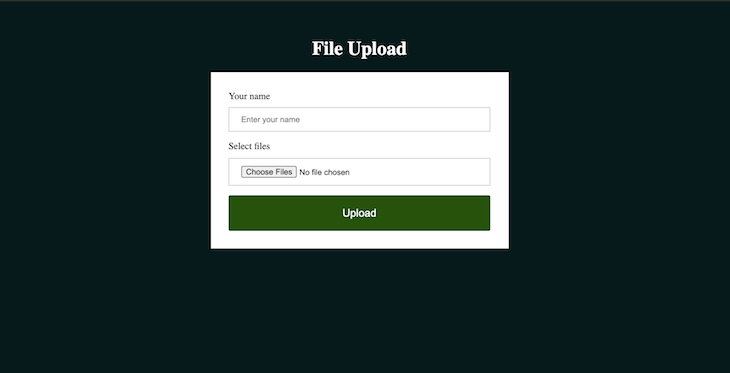
Every bit you lot can see, the course nosotros created takes ii inputs, proper name and files. The multiple attribute specified in the files input enables us to select multiple files.
Side by side, we'll send the form to the server using the code below:
// script.js const class = document.getElementById("grade"); form.addEventListener("submit", submitForm); function submitForm(due east) { due east.preventDefault(); const name = document.getElementById("name"); const files = document.getElementById("files"); const formData = new FormData(); formData.append("name", name.value); for(allow i =0; i < files.files.length; i++) { formData.append("files", files.files[i]); } fetch("http://localhost:5000/upload_files", { method: 'POST', trunk: formData, headers: { "Content-Type": "multipart/form-data" } }) .then((res) => panel.log(res)) .take hold of((err) => ("Fault occured", err)); } In that location are several important things that must happen when we use script.js. Kickoff, we get the class element from the DOM and add a submit event to information technology. Upon submitting, we apply preventDefaultto prevent the default action that the browser would have when a form is submitted, which would normally be redirecting to the value of the action attribute. Next, we get the proper name and files input element from the DOM and createformData.
From hither, we'll suspend the value of the name input using a key of proper name to the formData. Then, nosotros dynamically add together the multiple files we selected to the formData using a fundamental of files.
Note: if we're just concerned with a single file, we can append
files.files[0].
Finally, nosotros'll add together a Post request to http://localhost:5000/upload_files, which is the API on the backend that we'll build in the adjacent section.
Setting upward the server
For our demo, we'll build our backend using Node.js and Express. Nosotros'll set up a elementary API in upload_files and start our server on localhost:5000. The API will receive a POST request that contains the inputs from the submitted form.
To utilize Node.js for our server, nosotros'll need to fix a basic Node.js projection. In the root directory of the projection in the last at file-upload-case, run the following code:
npm init -y
The command in a higher place creates a basic package.json with some information about your app. Side by side, we'll install the required dependency, which for our purposes is Express:
npm i express
Side by side, create a server.js file and add the following code:
// server.js const express = require("express"); const app = limited(); app.utilize(express.json()); app.apply(express.urlencoded({ extended: truthful })); app.post("/upload_files", uploadFiles); part uploadFiles(req, res) { panel.log(req.body); } app.listen(5000, () => { console.log(`Server started...`); }); Limited contains the bodyParser object, which is a middleware for populating req.body with the submitted inputs on a form. Calling app.employ(express.json()) executes the middleware on every request made to our server.
The API is ready with app.post('/upload_files', uploadFiles). uploadFiles is the API controller. As seen to a higher place, we are just logging out req.body, which should be populated by epxress.json(). Nosotros'll exam this out in the example below.
Running body-parser in Express
In your last, run node server to start the server. If done correctly, you lot'll see the following in your last:
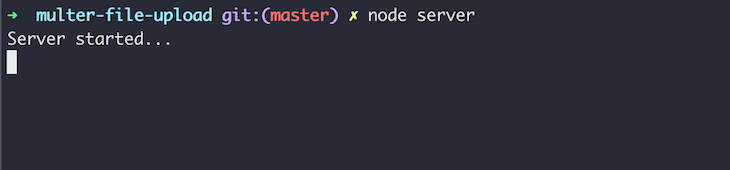
You tin now open up your frontend app in your browser. Fill in both inputs in the frontend, the name and files, and then click submit. On your backend, you lot should run across the following:
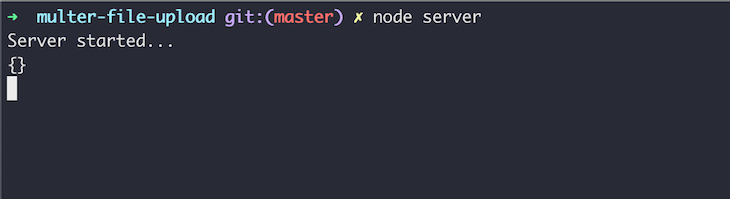
The code in the image above means that the req.body object is empty, which is to be expected. If yous'll think, body-parser doesn't support multipart data. Instead, we'll use Multer to parse the form.
Install and configure Multer
Install Multer by running the following command in your terminal:
npm i multer
To configure Multer, add the following to the top of server.js:
const multer = require("multer"); const upload = multer({ dest: "uploads/" }); ... Although Multer has many other configuration options, we're simply interested in thedest property for our project, which specifies the directory where Multer volition save the encoded files.
Next, we'll use Multer to intercept incoming requests on our API and parse the inputs to brand them available on the req object:
app.mail service("/upload_files", upload.array("files"), uploadFiles); function uploadFiles(req, res) { panel.log(req.trunk); console.log(req.files); res.json({ message: "Successfully uploaded files" }); } To handle multiple files, employ upload.array. For a single file, apply upload.single. Notation that the files argument depends on the name of the input specified in formData.
Multer will add the text inputs to req.body and add the files sent to the req.files array. To see this at work in the terminal, enter text and select multiple images on the frontend, then submit and check the logged results in your last.
As yous tin can encounter in the case beneath, I entered Images in the text input and selected a PDF, an SVG, and a JPEG file. Below is a screenshot of the logged result:
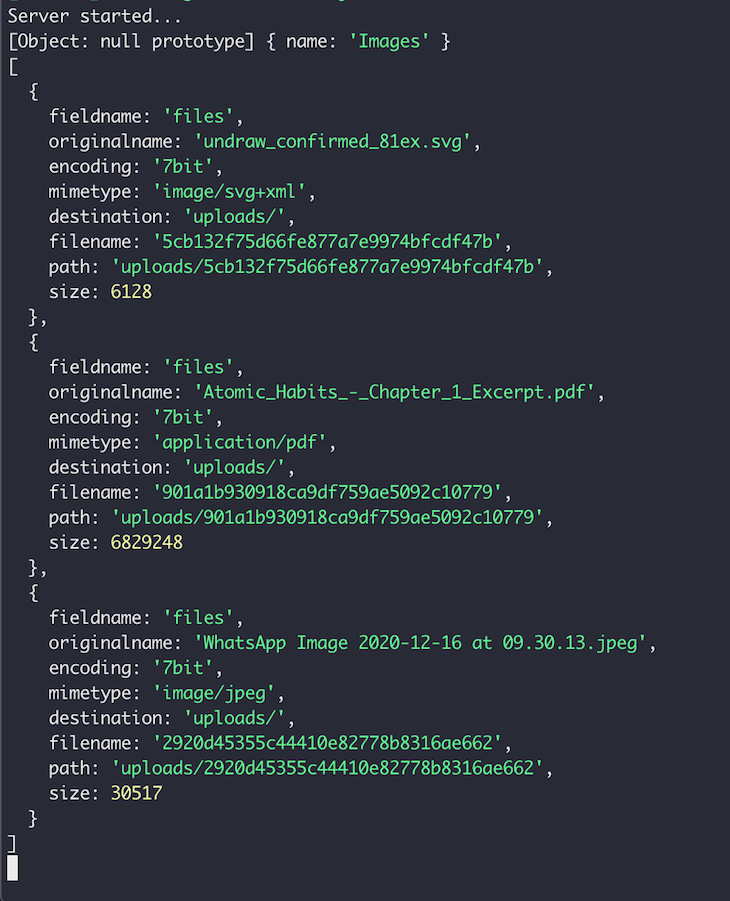
For reference, if you desire to upload to a storage service like Cloudinary, you will have take to send the file direct from the uploads folder. The path belongings shows the path to the file.
Determination
For text inputs alone, the bodyParser object used inside of Express is enough to parse those inputs. They make the inputs available as a fundamental value pair in the req.trunk object. Multer comes in handy when forms incorporate multipart data that includes text inputs and files, which the body-parser library cannot handle.
With Multer, you can handle unmarried or multiple files in addition to text inputs sent through a grade. Call up that you should only use Multer when you're sending files through forms, considering Multer cannot handle any class that isn't multipart.
In this article, we've seen a brief of form submissions, the benefits of trunk parsers on the server and the role that Multer plays in handling course inputs. We also built a small application using Node.js and Multer to come across a file upload process.
For the side by side steps, you can look at uploading to Cloudinary from your server using the Upload API Reference. I hope you enjoyed this article! Happy coding!
200's merely  Monitor failed and slow network requests in production
Deploying a Node-based spider web app or website is the easy part. Making sure your Node case continues to serve resources to your app is where things get tougher. If yous're interested in ensuring requests to the backend or third party services are successful, try LogRocket.  https://logrocket.com/signup/
LogRocket is like a DVR for web and mobile apps, recording literally everything that happens while a user interacts with your app. Instead of guessing why issues happen, yous can aggregate and report on problematic network requests to quickly understand the root cause.
LogRocket instruments your app to record baseline functioning timings such as page load fourth dimension, time to first byte, tedious network requests, and also logs Redux, NgRx, and Vuex actions/state. Outset monitoring for free.
Source: https://blog.logrocket.com/multer-nodejs-express-upload-file/
0 Response to "Using Multer to Upload Files React Mongoose Deployed Site"
Postar um comentário